

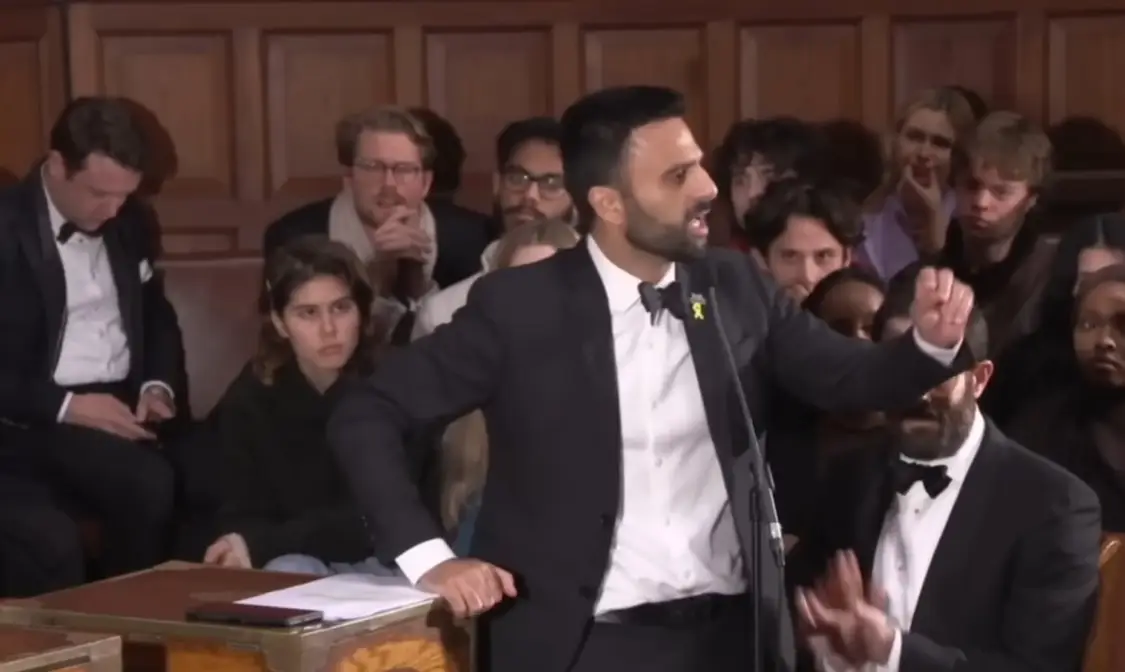
The grand hall of the Oxford Union buzzed, a familiar stage for intellectual sparring. But on this particular evening, the air crackled with a different kind of energy. Yoseph Haddad, an Arab Israeli, stood at the podium, his voice a raw, unfiltered testament against a tide of prevailing narratives. I watched, not merely as an observer, but as someone drawn into a story that transcended the usual academic debate.
Haddad didn’t begin with statistics or policy analyses. He started with his childhood, a mosaic of shared football games and holiday celebrations in Haifa and Nazareth. He spoke of playing with Jewish, Christian, Muslim, and Druze friends, a reality that seemed to defy the stark divisions painted by his opponents. It was a masterstroke, a humanizing narrative that immediately challenged the abstract accusations of apartheid.

I could almost feel the phantom sting of the Maxim restaurant bombing as Haddad recounted it. This wasn’t just a statistic; it was a visceral memory, a moment that transformed his decision to serve in the IDF from a choice to a moral imperative. He wasn’t reciting talking points; he was sharing a piece of his soul.
Then came the historical counterpunches. He dissected the period between 1948 and 1967, questioning why Egypt and Jordan, the custodians of Gaza and the West Bank, hadn’t established a Palestinian state. The “From the river to the sea” slogan, so often chanted with fervor, was stripped of its romanticism, revealed as a hollow mantra by someone who understood the land’s complexities.
Haddad’s direct confrontation was both audacious and compelling. He didn’t shy away from labeling his detractors “terror supporters,” forcing them to confront the uncomfortable implications of their stances. He paraded examples of Arab Israeli success—a judge who imprisoned Jewish leaders, a banker who defied stereotypes—each anecdote a brick in his counter-narrative.
The stories of Islam Hai and the kidnapped Arab Muslims, Yousef and Hamza, were particularly poignant. They were not just victims of circumstance; they were individuals caught in the crossfire of a conflict that often reduced them to faceless statistics. These stories, I felt, were the heart of Haddad’s message: a plea for recognition of the nuanced reality of life in Israel.
As Haddad defended the IDF’s actions, emphasizing the distinction between combatants and civilians, I understood his perspective. The fog of war is often thick, and the lines blurred, but his words offered a glimpse into the impossible choices faced by those on the front lines.
His assertion of identity as an Arab Israeli, his rejection of the “collaborator” label, resonated deeply. This wasn’t just a political stance; it was a declaration of belonging, a refusal to be defined by the narratives of others.
From the Author:
Watching Haddad, I was struck by the power of personal narrative in shaping perceptions. In an age of sound bites and ideological echo chambers, his voice was a refreshing reminder of the human element in complex conflicts. He didn’t offer easy answers, but he did something far more valuable: he challenged us to question our assumptions, to look beyond the surface, and to acknowledge the multifaceted reality of the Israeli-Palestinian conflict.
Haddad’s speech wasn’t perfect. Some might criticize his selective use of evidence or his dismissal of Palestinian grievances. But to me, his imperfections were part of his authenticity. He wasn’t a polished politician or a seasoned diplomat; he was a man speaking from the heart, sharing his truth.
In the end, Haddad’s stand at Oxford was more than just a debate performance. It was a story, a testament to the power of individual experience in shaping our understanding of the world. And as I left the hall, I couldn’t help but wonder how many more stories like his were waiting to be heard.













2 Responses
Yoseph Haddad’s speech is a powerful reminder of how personal narratives can disrupt entrenched political narratives. His childhood stories of coexistence in Haifa and the visceral account of the Maxim bombing don’t just argue against labels like “apartheid”—they humanize a conflict often reduced to binaries. By spotlighting Arab Israelis like Judge George Karra or banker Samer Haj Yehia, he forces us to confront the complexity of identity in Israel. While statistics and policies have their place, it’s these lived experiences that challenge us to see beyond headlines. Even if one disagrees with his views, his courage to voice an unconventional perspective in polarized times is commendable.
While Haddad’s personal story is compelling, it risks oversimplification. His emphasis on Arab Israeli successes and IDF ethics doesn’t fully grapple with systemic issues like occupation or settlement expansion. The author notes he may dismiss Palestinian grievances—this feels like a gap. For instance, citing Jordan and Egypt’s inaction pre-1967 sidesteps Israel’s role in current territorial disputes. Personal narratives are vital, but they can’t standalone without addressing power imbalances. Hearing Palestinian voices alongside his would create a fuller picture. Nuance works both ways: humanizing one community shouldn’t mean silencing another.