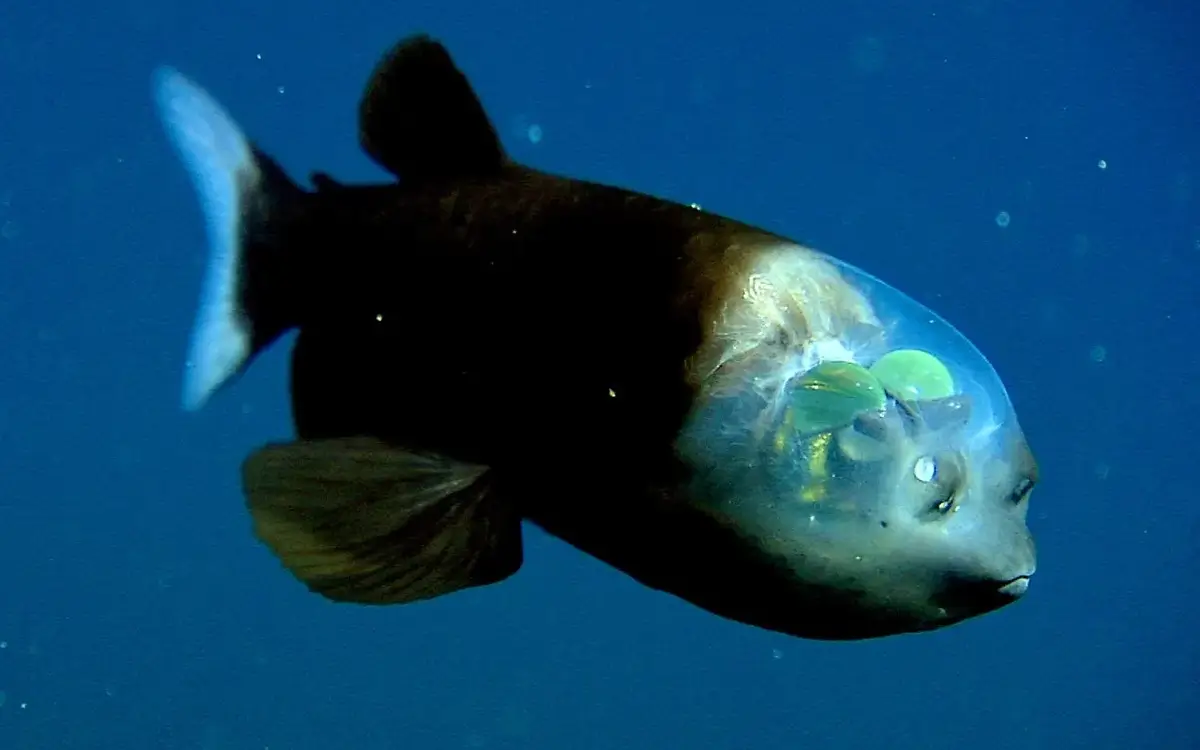
In the ocean’s shadowy twilight zone, between 600 and 800 metres beneath the surface, there are fish that gaze upwards through their transparent heads with eyes like mesmerising emerald orbs. These domes are huge spherical lenses that sit on a pair of long, silvery eye tubes – hence its common name, the barreleye fish (Macropinna microstoma).
The green tint (which actually comes from a yellow pigment) acts as sunglasses, of a sort, to help them track down their prey. There’s nowhere to hide in the open waters of the deep ocean and many animals living here have glowing bellies that disguise their silhouette and protect them – bioluminescent prey is hard to spot against the dim blue sunlight trickling down. But barreleyes are one step ahead.

Their eye pigment allows the fish to distinguish between sunlight and bioluminescence, says Bruce Robison, deep-sea biologist at the Monterey Bay Aquarium Research Institute in California. It helps barreleyes to get a clear view of the animals trying to erase their shadows.
The barreleye’s tubular eyes are extremely sensitive and take in a lot of light, which is useful in the inky depths of the twilight zone. But Robison was initially mystified that their eyes seemed fixed upwards on the small spot of water, right above their heads.
“It always puzzled me that their eyes aimed upward, but the field of view did not include their mouths,” says Robison. Imagine trying to eat scraps of food floating in front of you, while fixing your eyes on the ceiling.
But, after years of only seeing dead, net-caught specimens, Robison and colleagues finally got a good look at a living barreleye through the high-definition cameras of a remotely operated vehicle. “Suddenly the lightbulb lit and I thought ‘A-ha, that’s what’s going on!’,” he says. “They can rotate their eyes.” This means the fish can track prey drifting down through the water until it is right in front of their mouth.
Seeing a barreleye alive in the deep, Robison saw something else that scientists had previously missed. “It had this canopy over its eyes like on a jet fighter,” he says, referring to the transparent front part of the barreleye’s body, which had been torn off all the specimens he had previously brought to the surface.
He thinks this canopy probably helps protect their eyes as they steal food from among the stinging tentacles of siphonophores – animals that float through the deep sea in long, deadly strings, like drift nets.
Barreleyes have been found with a mix of food in their stomachs, including siphonophores’ tentacles, as well as animals that siphonophores feed on, including small crustaceans called copepods. Their tactic may be to swim up to siphonophores and nibble on the small prey snagged in their tentacles, using the transparent shield to protect their green eyes from stings.
But encountering barreleyes in the wild is not easy. In his 30-year career, Robison says he has only seen these 15cm-long fish alive maybe eight times. “We do spend a lot of time exploring down there, so I can say with some confidence that they’re quite rare,” he says.