

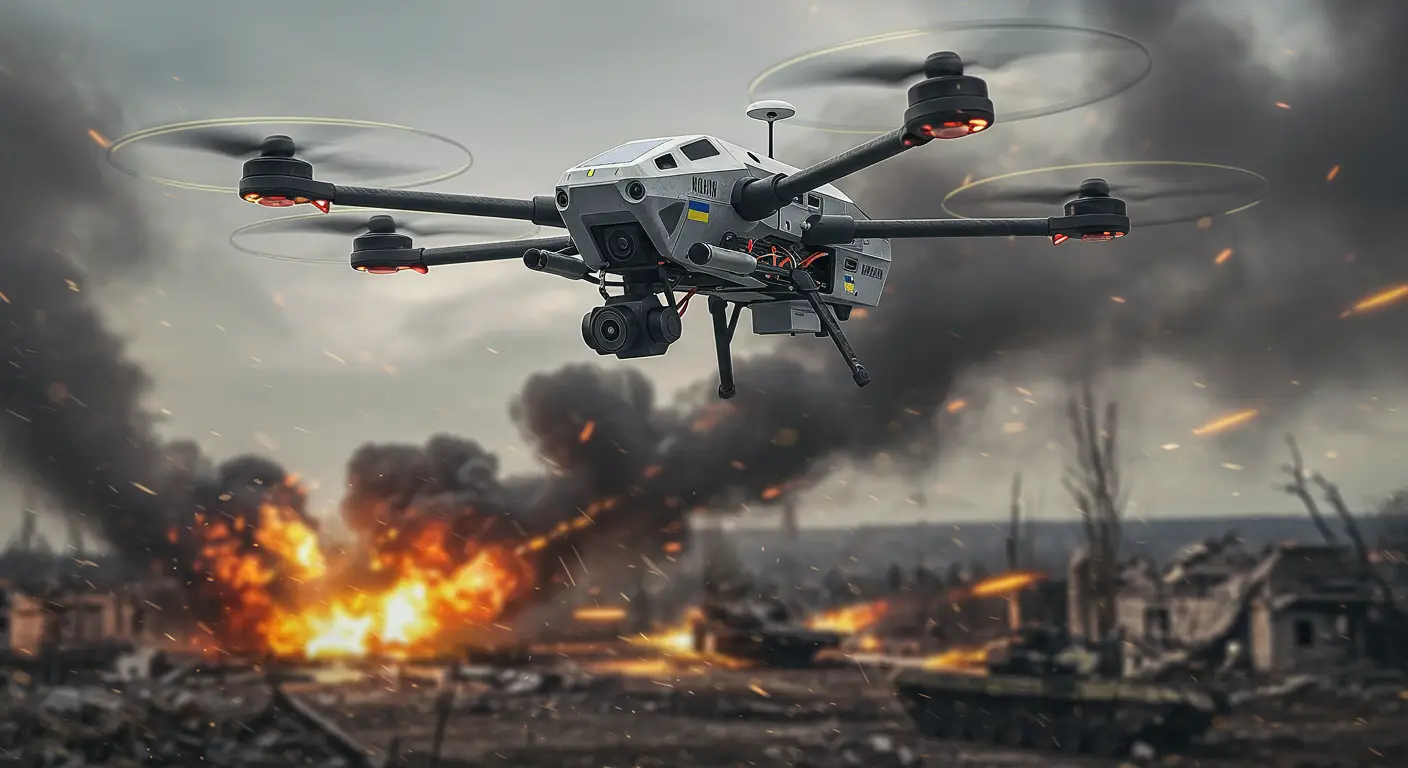
As I’ve tracked the rise of FPV drones—those nimble, pilot-controlled quadcopters flown through immersive goggles—I’ve become captivated by how artificial intelligence (AI) and mesh networking are propelling them from niche gadgets to transformative tools. Nowhere is this more evident than in Ukraine, where these technologies are rewriting the rules of warfare against Russia. But their impact stretches far beyond the Black Sea and Donetsk, influencing global military and commercial landscapes. Here’s my detailed take on how AI and mesh networking work in FPV drones, why they’re succeeding, and what they mean for the future.
AI in FPV Drones: From Human Skill to Machine Precision
When I first encountered FPV drones, I saw them as extensions of their pilots—fast, agile, and reliant on human reflexes. But AI’s changing that, and I’m intrigued by its role.

- Functionality and Purpose: In Ukraine, AI isn’t about full autonomy—it’s a practical assist. It handles target recognition, stabilizes flight, and ensures mission completion if signals falter. Picture an FPV drone chasing a Russian tank: AI identifies the target’s shape or heat signature, locks on, and adjusts trajectory mid-flight. A January 2025 report I found on X described an FPV striking a Pantsir-S1 air defense system near Crimea after losing pilot contact—AI took over and sealed the deal. Globally, companies like Skydio in the U.S. push AI further, enabling obstacle avoidance and autonomous pathfinding, while China experiments with swarm intelligence.
- Technical Breakdown: Ukraine’s approach is lean and mean. The AI runs on compact hardware—think NVIDIA Jetson Nano or Raspberry Pi 4, costing $100-$200 each—with processing power around 1-2 teraflops. These boards crunch lightweight neural networks, likely based on open-source frameworks like YOLOv5, trained on datasets of tanks, trucks, and thermal signatures. Power consumption’s minimal—5-10 watts—fitting the drone’s 15-30 minute battery life (typically 1,000-2,000 mAh LiPo packs). Video feeds at 720p (30 fps) stream through 5.8 GHz analog signals, with AI processing latency around 50-100 ms. Compare that to Skydio’s X2D, which boasts 4K vision and 10 teraflops but costs $10,000 per unit.
- Development and Cost: I estimate Ukraine’s AI R&D at $500,000-$1 million total—coders in Kyiv tweaking open-source code, not building from scratch. That’s a fraction of the $5 million DARPA spends on swarm AI for U.S. drones. Per drone, AI adds $50-$100—cheap enough to keep unit costs at $400-$600. The payoff? A 20-30% boost in hit accuracy, turning a $500 drone into a $24 million tank-killer.
- Ukraine’s Advantage: What impresses me is the speed. Ukraine’s battlefield feedback loop—pilots reporting, techs tweaking—means AI evolves fast. A December 2024 X post noted FPVs with “rudimentary autonomy” hitting moving targets at 40 kph, a feat Russia’s night-vision FPVs struggle to match. Globally, this simplicity could inspire smaller militaries—why spend millions when $1 million gets you there?
- Challenges: AI’s not perfect. It’s basic—no complex swarming yet—and false positives (e.g., mistaking a decoy) could waste drones. Russia’s captured intact FPVs, risking tech leaks, and scaling to millions needs more robust chips, which Ukraine’s supply chain struggles to secure.
Mesh Networking: Weaving a Resilient Web
Mesh networking’s the other half of this tech story, and I’m hooked on how it keeps FPV drones connected under fire.
- Functionality and Purpose: In a mesh network, every drone’s a relay node. If one FPV’s 5 km out and loses direct signal, another 2 km closer bounces the feed. In Ukraine, this stretches range from 5-10 km to 20-40 km with multiple hops. A December 2024 X post described a swarm of five FPVs chaining signals to strike a Russian helicopter 30 km away near Donetsk—mesh made it possible. Globally, the U.S. Navy’s Sea Hunter USV uses mesh for fleet coordination, and China’s 50-drone swarms rely on it, but Ukraine’s applying it to low-cost FPVs with stunning effect.
- Technical Breakdown: The setup’s elegantly simple. Drones use 2.4 GHz or 5.8 GHz transceivers—think FrSky or TBS Crossfire modules, $20-$50 each—running custom mesh firmware like OpenHD. Bandwidth’s tight—1-5 Mbps, enough for 720p video at 30 fps—but latency creeps up: 50-100 ms per hop, so three hops (15 km) might lag 300 ms. That’s still flyable for skilled pilots. Power draw’s 1-2 watts, sipping from the same battery as the motors. Encryption’s basic (AES-128, I’d wager), but Ukraine bolsters it with Starlink terminals ($2,500 each) or Kymeta satellite backups for long-range ops, dodging Russia’s jamming.
- Development and Cost: I’d peg Ukraine’s mesh R&D at $1-$2 million—tweaking commercial gear, not reinventing it. Per drone, it’s $30-$50 extra, keeping costs low. For a battalion’s 100-drone network, that’s $50,000-$100,000 total—compare that to the U.S.’s $500,000+ for Sea Hunter’s mesh. The return? Doubled range and resilience, letting a $500 drone punch 40 km deep.
- Ukraine’s Advantage: Russia downs 100 Ukrainian drones daily with jammers, per X posts, but mesh scatters the signal—lose one node, and the net holds. A 2024 strike on a Black Sea target 20 km out showed this in action: three FPVs relayed, one hit. Globally, NATO’s 2024 REPMUS exercise off Portugal tested mesh FPVs, hinting at adoption, but Ukraine’s real-time war lab gives it an edge.
- Challenges: Lag’s a killer—too many hops, and pilots lose control. Bandwidth limits swarm size to dozens, not hundreds. Russia’s electronic warfare adapts fast, and scaling mesh to Ukraine’s 2.5 million yearly FPVs needs industrial-grade hardware, not garage rigs.
Financial Implications: A Low-Cost Revolution
I love the numbers here. AI and mesh add $80-$150 per FPV—total cost $400-$600—yet deliver exponential impact. In Ukraine, a $600 drone with these techs destroys $24 million in Russian gear (40,000:1 ROI) or relays intel 40 km, doubling its value. R&D’s a steal—$1-$2 million total—versus $20 million for U.S. USV AI. Globally, the FPV market’s $1-$2 billion now, with Ukraine’s $75-$125 million yearly spend (2.5 million drones) a key driver. I see it hitting $5 billion by 2030 as militaries and firms catch on.
- Strengths: Low cost, high scalability—$100 million in FPVs causes $10 billion in damage (100:1 ratio). AI boosts precision; mesh extends reach. Ukraine’s crowdfunding (United24) and state tenders keep it lean.
- Weaknesses: Supply chain fragility—chips from Asia could dry up, hiking costs 20%. R&D’s constant—$1-$2 million yearly to counter Russia’s moves. Production’s artisanal, not industrial.
Global Context and Trends
Ukraine’s not alone. The U.S. spends millions on AI (Skydio’s $10 million contracts) and mesh (DARPA’s $50 million Gremlins), aiming for swarms of 100+ drones. China’s BeiDou-backed meshes coordinate 50-drone fleets in the South China Sea, costing tens of millions. Europe’s REPMUS trials signal NATO interest, but Ukraine’s $2 million investment outshines them in real-world results. I see a split: high-end players like the U.S. and China chase complexity; Ukraine proves simplicity wins wars.
Future Prospects
I’m excited for what’s next. In Ukraine, AI could evolve to swarm tactics by 2026—10 FPVs self-coordinating for $5 million in R&D. Mesh might tap 5G, cutting latency to 20 ms and scaling to hundreds, though that’s $10 million to deploy. Globally, I expect hybrid AI/mesh systems—think $1,000 FPVs with U.S.-grade smarts—driving a $5 billion market. Risks like jamming and tech theft loom, but the trajectory’s upward.
My Conclusion
AI and mesh networking are why FPV drones are 2025’s breakout stars. Ukraine’s $2 million investment turns $500 drones into tank-shredding, ship-sinking legends, outpacing Russia’s $158 million defenses. Globally, it’s a blueprint—low-cost tech with outsized impact. As I watch Kyiv’s coders and pilots push limits, I’m convinced this is just the beginning. Whether in war or commerce, FPV drones with AI and mesh are here to stay—and I can’t wait to see where they fly next.
How does AI make FPV drones more effective, especially in Ukraine?
I’ve been amazed by how AI supercharges FPV drones, and in Ukraine, it’s a game-changer. It’s not about full autonomy—think of it as a smart assistant. AI handles target recognition, spotting a tank’s shape or heat signature, and locks on, even adjusting flight if the pilot’s signal cuts out. I saw a post on X about a January 2025 strike near Crimea where an FPV hit a Pantsir-S1 after losing contact—AI finished the job. It runs on cheap hardware, like a $100 NVIDIA Jetson Nano, and costs maybe $500,000 to develop in Kyiv’s workshops. That boosts hit rates by 20-30%, turning a $500 drone into a $24 million tank-killer. Globally, the U.S. and China go bigger—Skydio’s AI dodges obstacles, China’s swarms—but Ukraine’s lean version proves you don’t need millions to win.
What’s the deal with mesh networking in FPV drones, and why does it matter in Ukraine?
Mesh networking’s my favorite part—it’s like giving FPV drones a group chat. Each drone relays signals, so if one’s 5 km out and loses the pilot, another bounces the feed, stretching range to 20-40 km. In Ukraine, I read about a December 2024 strike where five FPVs chained signals to nail a Russian helicopter 30 km away near Donetsk—mesh kept them linked despite jammers. It’s cheap—$20-$50 transceivers per drone, maybe $1 million total to develop—and uses Starlink as a backup. Russia downs 100 drones a day, but mesh keeps the net alive. Globally, the U.S. and China use it for swarms, but Ukraine’s scrappy setup doubles a $500 drone’s reach, making it a battlefield must-have.
How do AI and mesh networking affect the cost and impact of FPV drones financially?
I love crunching these numbers. In Ukraine, AI and mesh add $80-$150 per FPV—total cost $400-$600—with R&D around $1-$2 million. That’s peanuts compared to the U.S.’s $20 million USV AI budgets. The impact? Insane—a $600 drone with these techs can destroy $24 million in gear, a 40,000:1 ROI. Ukraine’s 2.5 million FPVs yearly ($75-$125 million) might cause $10 billion in Russian losses—100:1 ratio. Globally, the FPV market’s $1-$2 billion now, and I see it hitting $5 billion by 2030 as others copy this. The catch? Supply chains and constant upgrades cost extra, but for me, it’s a no-brainer—low investment, massive return.










One Response
mkmkm