

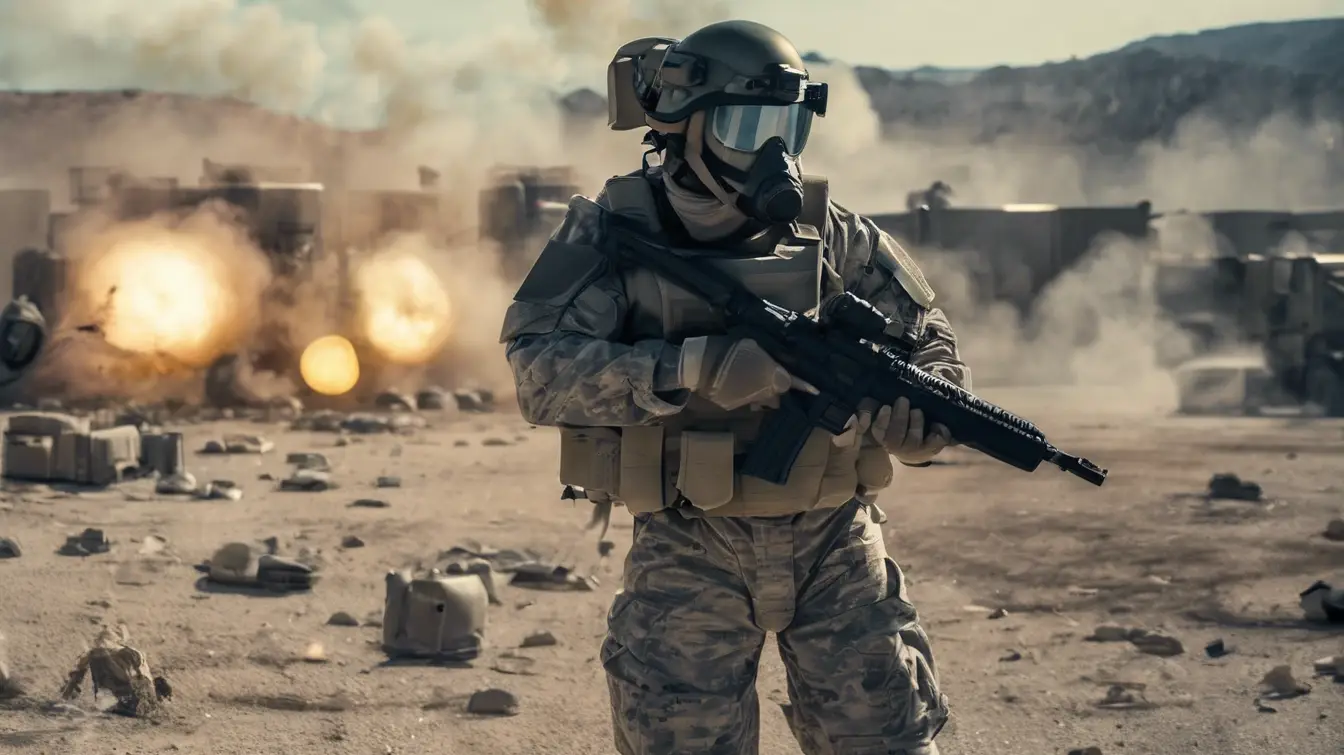
As chemical warfare threats loom larger in an unstable world, the U.S. military is quietly revisiting a technology with roots in the Cold War: Silent Discharge Processing (SDP). This non-thermal plasma system, proven to neutralize nerve agents and other deadly gases, could redefine chemical warfare defense—and unlock a $1–2 billion market for the Pentagon and its allies. With historical backing from the Naval Research Laboratory (NRL) and the U.S. Army, SDP is poised to shift from lab curiosity to battlefield asset. But can it deliver the financial returns to match its scientific promise?
A Military Legacy in Plasma Technology
Silent Discharge Processing, often called dielectric barrier discharge, first caught the military’s eye in 1985. The NRL, funded by the U.S. Office of Naval Research, successfully decomposed dimethyl-methyl-phosphate (DMMP)—a simulant for nerve agents like sarin—using SDP reactors. By 1992, the U.S. Army Chemical Research, Development, and Engineering Center (CRDEC) was testing plasma-based air purification, touting SDP’s edge over activated carbon filters. Unlike traditional systems, SDP neutralizes all known chemical and biological agents, offering a game-changing capability for troops in contaminated zones.

Today, with chemical attacks resurfacing in conflicts like Syria, the need for advanced chemical warfare defense is urgent. SDP’s ability to break down hazardous compounds into harmless byproducts (e.g., CO₂ and H₂O) at low temperatures makes it a standout. From mobile air purifiers to decontamination units, its military applications are vast—and lucrative.
Market Value: A $1–2 Billion Opportunity for the DoD
The global chemical and biological defense market, valued at $16.8 billion in 2023, is growing at a 5–7% CAGR, per industry forecasts. By 2030, it could hit $25 billion, with chemical warfare defense technologies at the forefront. SDP, tailored for military use, could claim a 5–10% share—translating to $1–2 billion annually—driven by demand from the U.S. Department of Defense (DoD) and NATO allies.
The DoD’s 2024 budget, a hefty $850 billion, offers a clear funding pool. If SDP secures just 0.01% of this—$85 million—it could kickstart production of field-ready plasma reactors. Initial contracts for air purification systems or decontamination units could range from $50–100 million annually, scaling as adoption grows. NATO, with its $1.2 trillion collective defense spending, adds further upside. A single SDP unit, priced at $1–2 million, could see sales of 50–100 units yearly by 2030, pushing revenues toward $200 million in the U.S. alone.
Financial Breakdown: Costs vs. Returns
Deploying SDP isn’t cheap. Developing military-grade reactors requires $5–10 million annually in R&D, building on decades of work at NRL and CRDEC. A pilot-scale unit costs $2–5 million, while scaling production could demand $50–100 million upfront. Yet, the payoff justifies the spend. Low operational costs—electricity versus fuel-intensive alternatives—yield 20–30% margins. A $100 million contract could net $20–30 million in profit, with break-even achievable in 3–5 years.
Funding isn’t a pipe dream. The DoD’s SBIR/STTR programs offer $1–5 million per phase for tech like SDP. Pair this with private investment—defense tech VCs could inject $20–50 million—and the financial runway extends. A partnership with Lockheed Martin or Northrop Grumman could fast-track deployment, though it might trim margins.
Competitive Edge in Chemical Warfare Defense
SDP faces rivals but holds unique advantages. Activated carbon filtration, the current standard, falters against complex agents and requires frequent replacement. Incineration, while effective, is impractical for mobile units. SDP’s low-temperature plasma reactors, by contrast, are compact, energy-efficient, and versatile—ideal for battlefield conditions. Early tests at LANL with simulants like trichloroethylene (TCE) reinforce its efficacy, giving it a technical edge.
Still, risks abound. Scaling SDP for rugged deployment remains unproven. Regulatory hurdles—military certification takes years—could delay cash flows. And with drones and cyber defenses vying for DoD dollars, SDP must prove its worth in a crowded budget.
The Strategic and Financial Imperative
The military case for SDP is clear: it’s a force multiplier against chemical threats. A single reactor could protect a battalion’s air supply or decontaminate gear post-attack, saving lives and cutting reliance on bulky logistics. Financially, it’s a calculated bet. If the DoD commits $50 million in 2025, SDP could be operational by 2028, with revenues climbing as conflicts drive demand. By 2035, a $1–2 billion market isn’t fanciful—it’s plausible.
A Cautious Optimism
Skeptics will note SDP’s limited real-world track record. Decades of lab success don’t guarantee battlefield reliability. The DoD’s spending is vast but fragmented—SDP must elbow past flashier tech to win funding. Yet, its alignment with national security priorities is undeniable. As chemical threats evolve, so must defenses. SDP offers a rare blend of proven science and untapped potential—a $1–2 billion question mark worth watching.
What is Silent Discharge Processing, and how does it help the military?
Silent Discharge Processing (SDP) is a non-thermal plasma technology that generates reactive species to break down chemical warfare agents, like nerve gases, into harmless byproducts such as CO₂ and H₂O. For the military, SDP offers a powerful defense against chemical threats. It can be used in compact reactors for air purification—protecting troops from contaminated environments—or for decontaminating equipment after an attack. Unlike traditional activated carbon filters, SDP neutralizes all known chemical and biological agents, making it a versatile tool for battlefield conditions. Research from the Naval Research Laboratory in 1985 and the U.S. Army in 1992 confirmed its potential, positioning it as a next-generation solution for chemical warfare defense.
How big is the market for Silent Discharge Processing in military applications?
The market for SDP in military use could reach $1–2 billion annually by 2030. The global chemical and biological defense market, valued at $16.8 billion in 2023, is growing at a 5–7% CAGR, potentially hitting $25 billion by the end of the decade. SDP could capture 5–10% of this, driven by demand from the U.S. Department of Defense (DoD) and NATO allies. With the DoD’s $850 billion budget in 2024, even a small slice—say, $50–100 million in initial contracts—could kickstart SDP’s growth. If 50–100 units are sold yearly at $1–2 million each, revenues could climb to $200 million in the U.S. alone, with NATO adding further upside.
What are the financial risks and rewards of investing in SDP for military use?
Investing in SDP is a high-stakes play. Costs include $5–10 million annually for R&D and $50–100 million to scale production, with pilot reactors at $2–5 million each. Break-even might take 3–5 years, assuming $100 million in early DoD contracts. The rewards, however, are substantial: low operational costs yield 20–30% margins, so a $100 million deal could net $20–30 million in profit. By 2035, a $1–2 billion market could deliver $200–300 million in annual profits if adoption scales. Risks include unproven field performance, regulatory delays, and competition from existing tech like filtration systems, but DoD grants ($1–5 million per phase) and VC funding ($20–50 million) could offset the gamble.
Why should the military prioritize Silent Discharge Processing over other technologies?
SDP stands out in chemical warfare defense for its efficiency and versatility. Unlike activated carbon filters, which struggle with complex agents and need frequent replacement, SDP neutralizes all threats in a single pass. Compared to incineration, it’s more energy-efficient and mobile—crucial for battlefield deployment. Early tests, like the NRL’s 1985 DMMP decomposition, proved its efficacy, while the U.S. Army’s 1992 research highlighted its air purification potential. In a world of evolving chemical threats, SDP’s ability to protect troops and decontaminate gear offers a strategic edge, justifying its $50–100 million initial investment from the DoD’s vast budget.















4 Responses
This sounds like a sci-fi solution—plasma reactors on the battlefield? I’m skeptical it’ll work outside a lab. The DoD wastes enough money on unproven tech already. Why should I believe SDP will be any different?
$1–2 billion market by 2030 is a bold claim! I like the margins you’re projecting, but what’s the real timeline for DoD contracts? And who’s going to foot the R&D bill—taxpayers or private cash?
Hi Irakli, I get the sci-fi vibe—plasma does sound futuristic! But SDP’s not just a lab dream; it’s got a track record. The Naval Research Lab proved it could zap nerve agent simulants back in 1985, and the Army’s 1992 tests showed it beats carbon filters for air purification. Sure, scaling it to battlefield chaos is a leap, and the DoD’s had its share of tech flops—$50–100 million could vanish if it stalls. The difference here is SDP’s low running costs and versatility, promising 20–30% margins if it works. It’s a risk, no doubt, but one grounded in decades of data, not just hype. What do you think—worth a shot given the chemical threat landscape?
Hey Irakli, glad you’re eyeing the numbers! The $1–2 billion projection hinges on the chemical defense market hitting $25 billion by 2030 (5–7% CAGR from $16.8 billion in 2023) and SDP snagging 5–10%. Ambitious? Yes, but DoD’s $850 billion budget could start with $50–100 million in contracts by 2028 if pilots succeed—think air purifiers for bases or mobile decon units. Timeline-wise, R&D’s already decades in (NRL, Army data), so 3–5 years to field-ready feels doable with focus. Funding’s a split: taxpayers via DoD grants ($1–5 million per SBIR phase) and private VCs ($20–50 million) smelling defense tech profits. A Lockheed tie-up could speed it up too. Where do you see the bigger payoff—military or elsewhere?